

What Is The Name Of The Program To Get That Can Clean Up An Electronic Voice Phenomena?
Nontrivial numbers of Americans believe in the paranormal. These beliefs accept spawned thousands of groups dedicated to investigating paranormal phenomena and a proliferation of ghost-hunting entries in the reality telly market. Anecdotal evidence even suggests that ghost-hunting reality shows take increased public openness to paranormal research, which usually entails a small group traipsing through reportedly haunted locales at night with various ghost-hunting technologies.
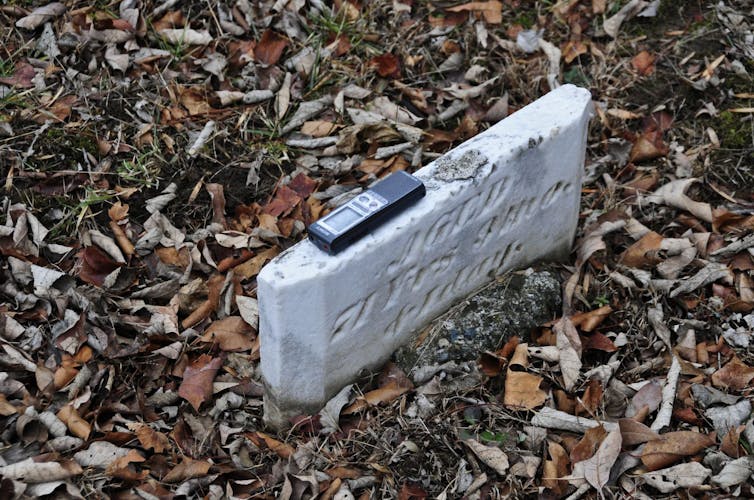
Sound recorders figure prominently in paranormal researchers' toolkits. Microphones capture ambient sounds during the investigation. Later, the sound recordings are scoured in search of messages from spirits. The premise is that audio recording devices can annals otherwise inaudible communications from discarnate entities.
These purported communications have been dubbed electronic voice phenomena (EVP). The sounds are mostly cursory – nigh examples consist of single words or short phrases. Perceived contents of EVP range from threatening ("You're going to hell") to bizarre ("Egypt Air").
Part of the attraction of the audio recorder for paranormal researchers is its credible objectivity. How could a skeptic refute the authenticity of a spirit captured by an unbiased technical instrument? To the believers, EVP seem like incontrovertible show of communications from beyond. But recent research in my lab suggested that people don't hold much about what, if anything, they hear in the EVP sounds – a result readily explained by the fallibility of human perception. Despite the technological trappings, EVP research bears several characteristics of pseudoscience.
What are the EVP sounds?
The chain of bear witness for well-nigh purported EVP makes hoaxes difficult to rule out, just let's presume that many of these sounds are non deliberate fraud. In some instances, alleged EVP are the voices of the investigators or interference from radio transmissions – bug that point shoddy data collection practices. Other research, however, has suggested that EVP take been captured under acoustically controlled circumstances in recording studios. What are the possible explanations for these sounds?
The critical leap in EVP research is the point at which odd sounds are interpreted as voices that communicate with intention. Paranormal investigators typically decode the content of EVP past arriving at consensus among themselves. EVP websites advise paranormal researchers to ask themselves, "Is it a voice…are y'all sure?" or to "Share results among fellow investigators and try to prevent investigator bias when reviewing data." Therein lies a methodological difficulty.
Research in mainstream psychology has shown that people will readily perceive words in strings of nonsensical speech sounds. People'south expectations about what they're supposed to hear tin effect in the illusory perception of tones, nature sounds, machine sounds, and even voices when merely acoustic white noise – like the sound of a detuned radio – exists. Interpretations of spoken language in noise – a situation similar to EVP where the declared vocalism is difficult to discern – can shift entirely based upon what the listener expects to hear.
EVP in the perceptual inquiry lab
In my lab, we recently conducted an experiment to examine how expectations might influence the perception of purported EVP. Our EVP were sound recordings from a ghost-hunting reality prove.
We asked iii questions: Do people perceive alleged EVP to be voices under controlled conditions? If they hear voices, do they agree about what the voices are saying without being told what they're supposed to hear? And finally, does it matter whether or not they think the enquiry topic is paranormal?
Half of participants were told that the experiment was role of a research project on paranormal EVP. The other half were told that nosotros were studying spoken communication perception in noisy environments – a typical (if maybe irksome) perceptual psychology experiment.
In a written report trial, participants heard a sound and were asked if they detected a vocalization in the stimulus. If they responded "no," the trial ended. If they responded "yep," they reported what they idea the voice had said. Across the study, participants heard the purported EVP, recordings of actual man voice communication, recordings of human speech obscured in noise, and recordings of only noise. The EVP and speech-in-dissonance sounds were inherently cryptic – they sort of sounded like a voice was nowadays and sort of did non.
Compared to the control condition, the proffer of a paranormal inquiry topic made people more than likely to study hearing voices for both the EVP (48% versus 34% "yes" responses) and the voices hidden in dissonance (58% versus xl% "yes" responses). For real human speech, all participants nearly always heard a voice (99% "yes" responses), and for noise all participants almost never heard a voice (1% "aye" responses). So suggesting a paranormal research topic mattered only when the audio was ambiguous.
Further, when people said they heard a voice in the EVP, only 13% agreed about exactly what the voice said. To compare, 95% per centum of people on average agreed well-nigh what the voice said when they heard actual speech.
In one final analysis, nosotros showed that the participants' interpretations agreed with the paranormal researchers' interpretations less than 1% of the time. These findings advise that paranormal researchers should non use their ain subjective judgments to confirm the contents of EVP.
Simply perhaps most importantly, nosotros showed that the mere suggestion of a paranormal enquiry context made people more than probable to hear voices in ambiguous stimuli, although they couldn't hold on what the voices were proverb.
A perceptual caption of EVP
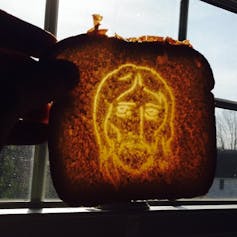
We concluded that EVP are an auditory case of pareidolia – the tendency to perceive human characteristics in meaningless perceptual patterns. There are many visual examples of pareidolia – things like seeing human faces in everyday objects (such equally Jesus in a piece of toast).
Enquiry from cognitive psychology has shown that paranormal believers may be especially prone to misperceiving hazard events. A face up-like configuration in a slice of toast seems meaningful. People enquire, "What are the chances?" But if yous add together upwardly all of the slices of toast you encounter over the days and weeks and months of a lifetime, information technology becomes inevitable that y'all will come across some of these human-like configurations in toast due to gamble.
Similarly, paranormal investigators record a practically limitless corporeality of sound and use all way of audio-processing techniques including filtering the sounds to remove item frequencies and boosting the volume. Inevitably they're able to find samples of audio that sound somewhat similar a voice.
Assuming some of these voice-like sounds can't be attributed to shoddy data drove practices, their actual sources likely run the spectrum from ambient environmental noises to electrical interference to audio processing artifacts. If the listener is intently expecting to hear a person, virtually any sound can run into that expectation. One writer aptly suggested that EVP are like an auditory inkblot test: a blank slate upon which the listener can project any interpretation. The trend for EVP investigators to hear a vox – a meaningful sound with agency and intention – is likely amplified by the suggestion of a paranormal context.
EVP research bears hallmarks of pseudoscience
In pseudoscience, in that location is a semblance of adherence to the values of science. Objectivity in EVP enquiry is equated with the use of a technological recording device per se, simply subjectivity permeates the critical step of interpreting what the sounds hateful. In science, objectivity is a critical value for researchers – an ideal that we endeavor to apply to all aspects of inquiry – rather than a characteristic of our equipment.
Another characteristic of pseudoscience is a lack of integration with related areas of inquiry. At that place is a rich history of using experimental methods to examine auditory perception, yet EVP enthusiasts are either unaware or willfully ignorant of this relevant work.
Science also values parsimony – the idea that the simplest explanation is preferred. To explain EVP equally the result of human auditory perception, we need a theory to account for how and why a man listener sometimes misperceives ambiguous stimuli.
In fact, this very tendency is one of many well-documented cognitive shortcuts that may have adaptive value. A voice may signal the presence of a potential mate or foe, then it may be useful to err on the side of perceiving agency in ambiguous auditory stimuli.
A paranormal theory is much more than circuitous. Nosotros accept to explain how disembodied entities larn agency. Nosotros take to explicate why they accept the power to produce audio simply only communicate in audio recordings instead of merely speaking aloud. We have to explain why they plainly can't speak clearly in full sentences, but only cursory, garbled, frequently seemingly random phrases.
What's the harm?
Many forms of popular entertainment require the suspension of disbelief, and viewers of paranormal reality shows are hopefully tuning in for the amusement rather than scientific value of these programs. There are many important public problems, however, for which pseudoscientific beliefs accept harmed public soapbox.
Currently, in that location is merely express, tentative prove to link exposure to pseudoscience on television to pseudoscientific beliefs. Still, 1 written report showed that people find paranormal research to be more than credible and scientific when it is shown using technological tools such equally recording devices. Other testify has suggested that popular opinion may outweigh scientific brownie when people evaluate pseudoscientific claims.
A skillful ghost story may concord entertainment and even cultural value, merely the popular portrayal of pseudoscientific practices equally science may be detracting from efforts to cultivate a scientifically literate public.

Source: https://theconversation.com/hearing-ghost-voices-relies-on-pseudoscience-and-fallibility-of-human-perception-48160
Posted by: mccuneeverytheir36.blogspot.com
0 Response to "What Is The Name Of The Program To Get That Can Clean Up An Electronic Voice Phenomena?"
Post a Comment